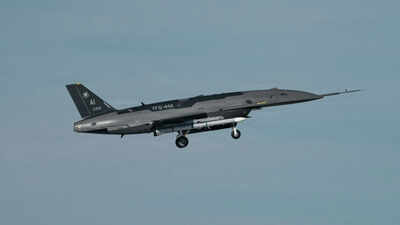
Ushering in the future of aerial warfare, the US Air Force (USAF) has awarded the first-increment contract for the Collaborative Combat Aircraft (CCA) programme.This marks the first operational step in how airpower will be acquired and deployed.Building on decades of semi‑autonomous flight research, CCAs are unmanned aircraft designed to integrate seamlessly with crewed fighters, extending reach, situational awareness and survivability in contested environments.Contracts awarded ahead of schedule confirm that General Atomics’ FQ-42 (Dark Merlin) and Anduril’s FQ-44 (Fury) meet mission requirements and are ready for full-scale production.These pilotless aircraft, intended for manned-unmanned teaming (MUM-T), elevate pilots to mission commanders who direct robotic wingmen as sensors, shooters and weapons carriers.The CCAs will fly ahead of manned platforms as weaponised eyes and ears and can absorb enemy fire, preserving the more expensive crewed aircraft. They will also reduce reliance on manned sorties while increasing combat mass.Concepts range from standardized aircraft capable of manned or unmanned operation to smaller, attritable drones such as Boeing’s MQ-28 Ghost Bat, which is undergoing flight testing.“Collaborative Combat Aircraft change how we project power and generate mass in highly contested environments,” said Air Force Chief of Staff Gen. Ken Wilsbach.“Delivering this capability to our warfighters faster ensures our forces maintain the tactical edge required to deter and, if necessary, defeat any adversary.”India is pursuing a parallel path through HAL’s Combat Air Teaming System (CATS). A twin-seat Tejas will act as the mothership, coordinating swarming UAVs and UCAVs.The centerpiece is the CATS Warrior, a low-observable loyal wingman developed by HAL and NewSpace Research & Technologies. First unveiled in 2021 and displayed as a prototype in 2025, Warrior reflects India’s growing confidence in indigenous innovation.By integrating drones and manned fighters into cohesive teams, CATS aims to deliver affordable combat mass, flexible mission execution and a future-ready force structure tailored to India’s operational needs.