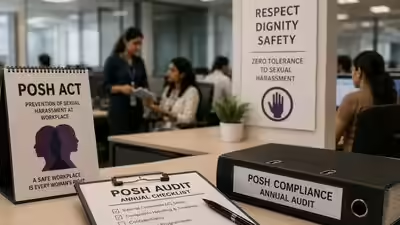
NEW DELHI: For years, many Indian workplaces have treated POSH guidelines as a box-ticking exercise — put up a policy, form a committee, file a report, and move on. The National Commission for Women wants to change that. On June 19, 2026, it issued an advisory to all states and Union Territories calling for mandatory annual audits of how workplaces are actually following the Sexual Harassment of Women at Workplace (Prevention, Prohibition and Redressal) Act, 2013.The advisory came weeks after the NCW’s own team visited TCS’s Nashik office in April and found that the Internal Committee had never even stepped into the unit it was supposed to protect. That case became the trigger for a much wider push.What has the NCW recommendedThe advisory has been sent all the way from chief secretaries and police chiefs down to district magistrates and commissioners of police across every state and Union Territory. The NCW has made clear that it wants this to reach every district and every workplace.The advisory recommends that any workplace with 10 or more employees — government offices, schools, hospitals, corporations, local bodies — should conduct mandatory annual POSH audits. And even smaller workplaces would not be exempt. For establishments with fewer than 10 employees, domestic workers and those in the informal sector, the NCW has called for every district to ensure that Local Committees are properly set up and functioning to handle their complaints.Maharashtra has already moved ahead. Days after the NCW advisory, the state government held a joint meeting of its women and child development and labour departments, chaired by WCD minister Aditi Tatkare, and decided to make POSH compliance checks mandatory during annual audits and inspections of all private companies.The state has also made it compulsory for all new private establishments seeking registration — and existing ones applying for renewal — to constitute an Internal Complaints Committee. Twelve officers have been authorised as inspection officers and assigned urban and rural jurisdictions across districts to monitor compliance.“Providing women with a safe and dignified workplace is every woman’s right. The government will not compromise on ensuring effective implementation of the POSH Act,” Tatkare said.What these audits would checkAccording to the advisory, the audit would not just verify whether a policy exists on paper. It would look at whether the Internal Committee is properly set up and actually doing its job, how complaints are being handled and within what timelines, whether confidentiality is being maintained, what awareness programmes have been held, whether the SHe-Box platform — the government’s online portal for registering workplace harassment complaints is being actively used and promoted, and whether all necessary information is publicly accessible on the organisation’s website and at the workplace.The NCW has further recommended that contact details of Internal Committees, Local Committees, Nodal Officers and complaint procedures should be easy to find and should not just be in the HR handbook that most employees would never read.What non-compliance could meanThe NCW has said that not conducting the annual audit should itself be treated as non-compliance under the POSH Act, which could attract a fine of up to Rs 50,000 under Section 26. Repeat violations could be fined double.The NCW has recommended that states set up dedicated POSH monitoring cells and digital dashboards to track compliance — rather than relying solely on what employers report about themselves. It has also called for Nodal Officers to be appointed at the block, tehsil, ward and municipality level to help women register complaints and reach Local Committees.The advisory further recommends proper training for committee members and calls for strong protection for complainants, witnesses and committee members against transfers, professional consequences or any form of retaliation.NCW chairperson Vijaya Rahatkar put it simply: “A woman should never have to choose between her dignity and her livelihood.”