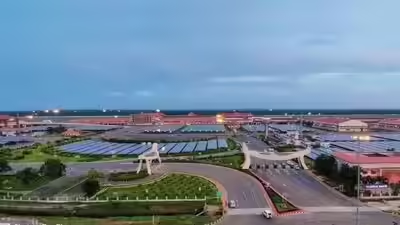
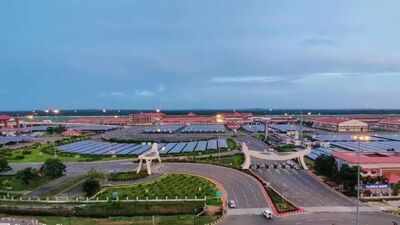
KOCHI: Kerala’s rooftop solar power generation has seen an exponential growth: from just 17MW in 2018 to over 2,500MW in 2026. The green energy production, undoubtedly, is a healthy development but here it has not just strained KSEB’s power network to its limits and posed other challenges, including an increased monthly bill for non-solar customers.The state launched Soura project in 2018 to promote solar energy generation and KSEB adopted measures, including awareness campaigns, to popularise it. But it was the launch of PM Surya Ghar project, which gives subsidies to prosumers (consumers producing energy), that ignited a boom in rooftop solar power generation.
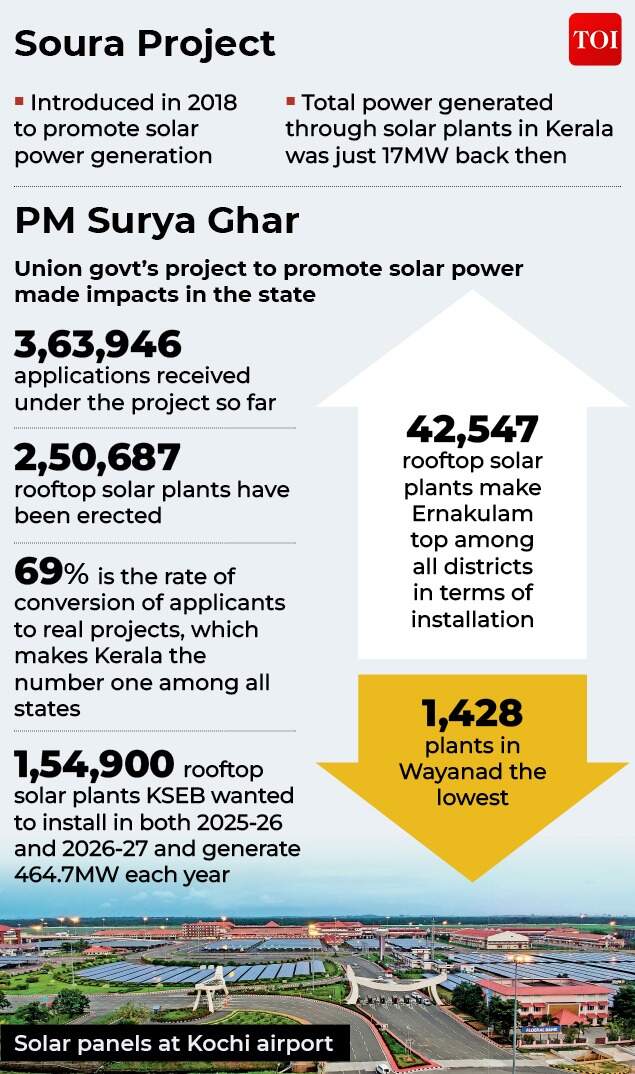
Soura project
The generation eventually saw transformers being loaded heavily with the power from the households and many of them reaching saturation levels, especially in urban areas. “A KSEB transformer can handle solar power to a maximum of 90% of its capacity. More load will lead to collapse of the system, including burning of transformers,” a KSEB official said.One way out is to augment infrastructure. Promoters of renewable energy believe that KSEB’s inability to do it in time is slowing down solar penetration.“Of the 90,000 transformers in the state, only around 1,050 have reached saturation level. They are in urban areas where potential prosumers are very high. If KSEB can’t augment their capacity, it can swap underutilised transformers with high-capacity ones. We request KSEB to urgently address the issue,” said Kerala Renewable Energy Entrepreneurs and Promoters Association general secretary Mohammed Shafeeq N.Another hurdle is the regulation introduced by the Union govt, making use of domestic content requirement (DCR) solar panels mandatory for all types of prosumers who are entitled to the benefit of net metering, where a prosumer is given back the same units of power that they give to KSEB’s grid without charging any cost.“Earlier DCR solar panels were mandatory only for those prosumers who availed govt subsidies while setting up the plants. Now, it is applicable to all prosumers who avail net metering facility. So, non-domestic or commercial consumers who avail net metering facilities have been forced to procure DCR panels. The total annual demand for DCR panels is up to 70 gigawatt while the current production caters to only 27 gigawatt. It takes three months to get the panels,” Shafeeq said.Around 75MW of solar power is being pumped into the KSEB’s grid every month and it causes a lot of technical and financial issues for the board.“KSEB introduced the net metering scheme to encourage more consumers to install solar plants. Prosumers supply power to KSEB grid during daytime when charge is less than Rs 2 per unit and draw the units from the grid at night when charge is Rs 10 per unit. The huge loss KSEB incurs thus is passed on to non-solar consumers through tariff hike,” a KSEB official said.
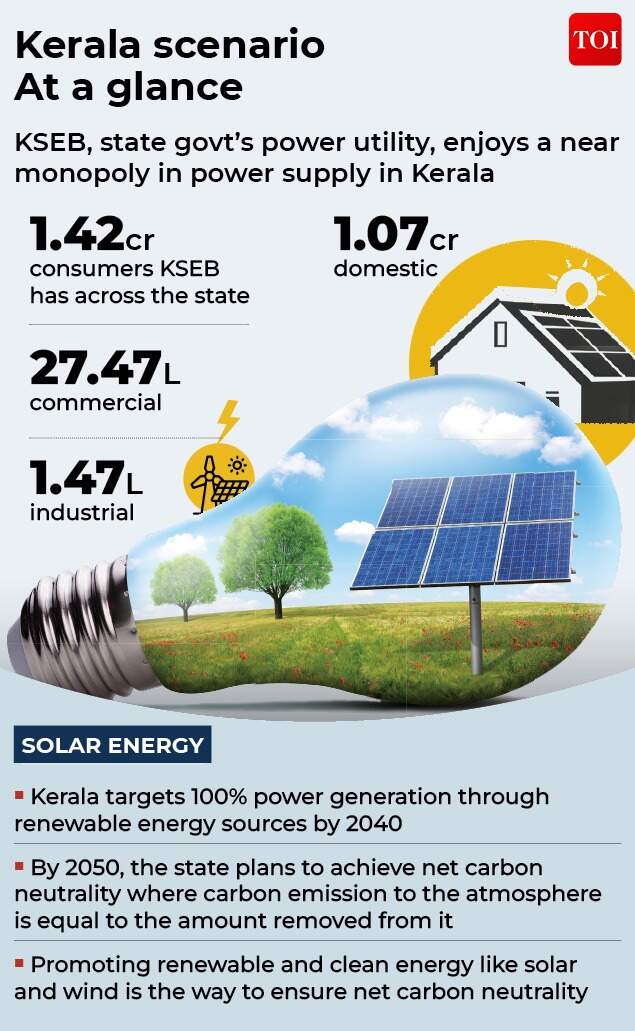
Kerala scenario at a glance
Central Electricity Authority as well as draft National Electricity Policy 2026 say that net metering can be allowed only up to 5KW but in Kerala it is allowed up to 20KW. A few months ago, Kerala State Electricity Regulatory Commission (KSERC) introduced a norm that net metering benefits can’t be allowed to commercial consumers.“KSERC also limited the net metering facility to domestic prosumers up to 10KW. If a domestic prosumer has a solar plant which generates 15KW and gives it to the KSEB grid and uses the same quantity of power from the grid later, they should give increased tariff for the additional power of 5KW used from the grid. But the prosumers’ associations moved the court and KSEB is still unable to implement the norms as it is sub-judice,” a KSEB source said.Prosumers say KSEB and the govt should take immediate steps to augment power utilities infrastructure. “KSEB should enhance the capacity of transformers. They should also take urgent steps to set up a battery energy storage system (BESS) at section-office level,” said Domestic On-grid Solar Power Prosumers Association president MA Sathar.But KSEB finds it tough to generate enough revenue. The number of commercial and industrial consumers is very high in other states, and they fetch their boards a better revenue, with a better daytime consumption to boot. KSEB’s 75% consumers are domestic which means consumption during daytime is just 25%.To make the most of solar power, KSEB started moves to commission six BESS units at different locations with a total capacity of 500MW by 2026, but only the 125MW project at Mylatti in Kasaragod has registered significant progress.“If govt lacks funds, private players must be allowed to set up BESS on a commercial basis. Given the penetration of electric vehicles and the ever-increasing use of air-conditioners, the state’s power requirement will touch 12,000MW from the current 6,000MW in a couple of years. From where will the KSEB get the power to meet the requirement then? Here lies the importance of solar power and BESS,” he added.To add to the concern, Union govt norms make it mandatory for state electricity boards to enter into long-term power purchase agreements. Solar electricity is an unfirm power (fluctuating) as a lot of deterrents including clouds curtail its generation. So KSEB will have to ensure a backup of equal volume of firm electricity like hydel power to ensure that the grid (which is connected to that of other states) does not collapse.
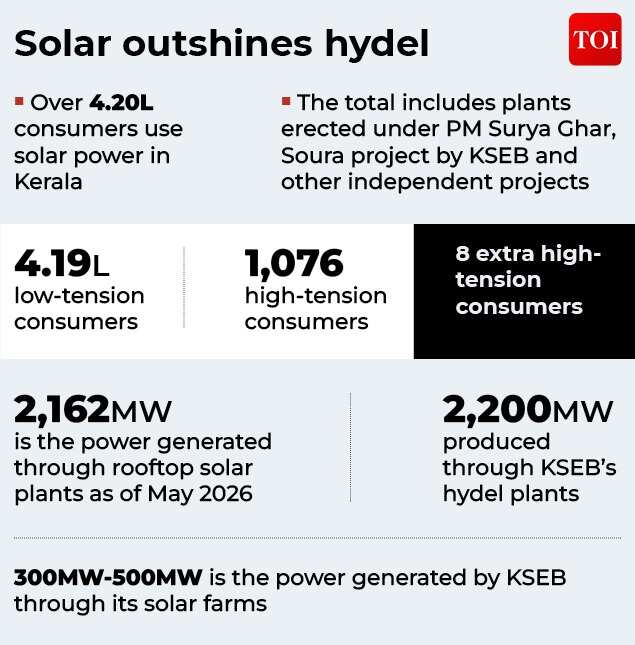
Solar outshines hydel
When summer peaks, up to 2,500MW solar power is generated but small hydel projects which operate using run-off water cease to operate, cutting down generation to 1,300-1,500MW. KSEB will have to purchase the remaining units required to match the solar power generation from firms, giving a fixed charge based on long-term agreements.Despite all odds, demand for solar plants is growing. Rooftop panel installations jumped to a whopping 20,000 in May this year after an average of 10,000 in the 11 months prior to it. The surge is attributed to the spike in the use of induction cookers and similar devices in the wake of LPG shortage caused by the Iran-USA war. It’s up to KSEB to translate the crisis into an opportunity.