

New Delhi: India moved up two places to emerge as the 11th biggest recipient of foreign direct investment (FDI in 2025, with inflows jumping 44% to $39 billion. The country is emerging as a preferred destination for investments in electronics, automobiles material and industrial manufacturing, the latest World Investment Report said.The UNCTAD publication also said India was the 18th largest overseas investor, again moving up two ranks, as outflows rose 50% to $36 billion in 2025. Large FDI outflows has resulted in the net inflows narrowing, which govt and economists have described as the growing global footprint of Indian companies and their participation in global value chains (GVCs).” India has emerged as a major recipient because of its scale, fast-growing digital demand, technical skills and expanding markets for cloud services,” the report said, adding that there has been a sustained push towards facilitating investment in manufacturing through initiatives, such as Production Linked Incentive scheme.
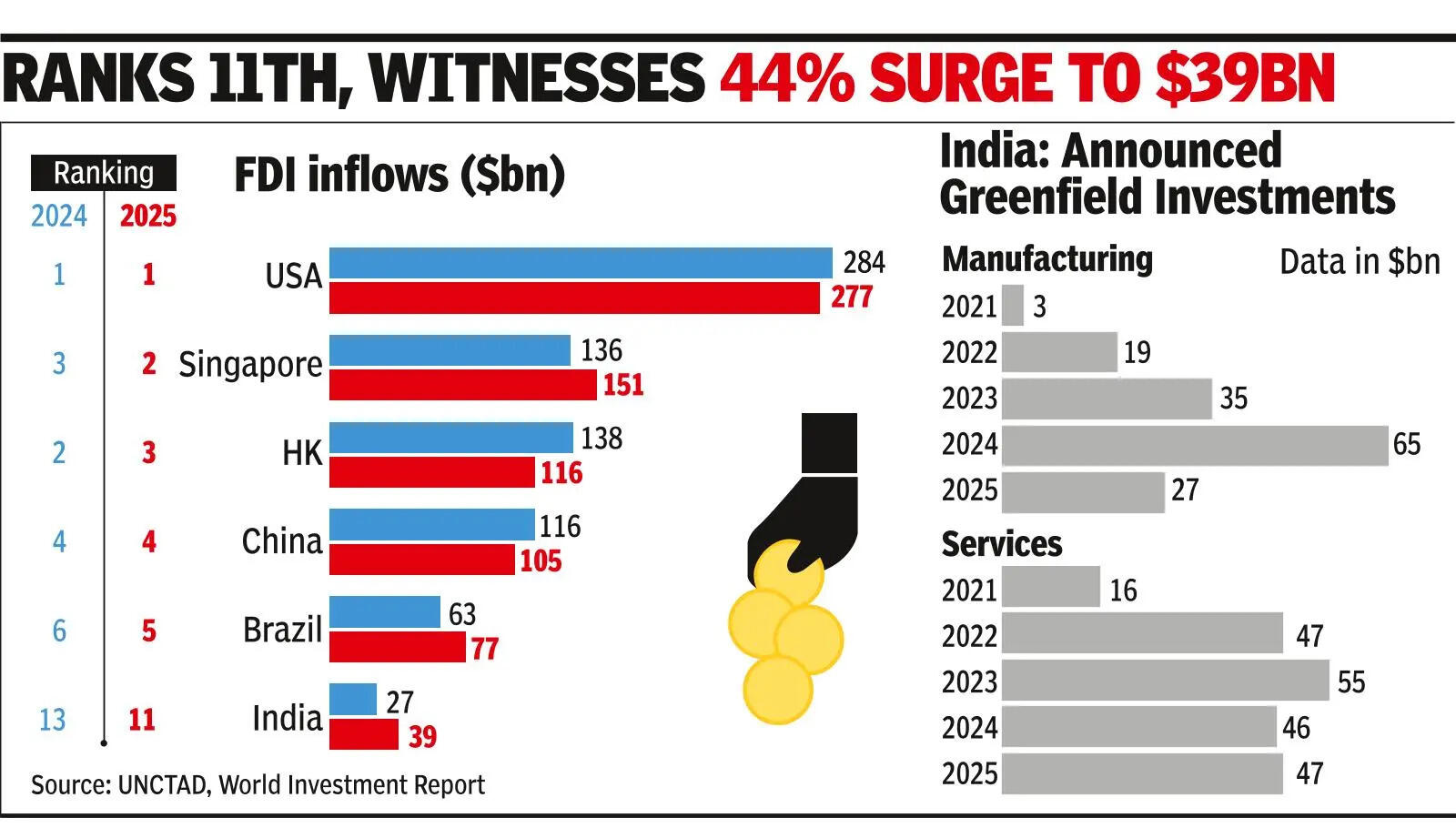
“The policy framework in India remains oriented towards advanced manufacturing, infrastructure development and deeper integration into GVCs. However, tariff uncertainty, supply chain realignment and weaker global investment sentiment are affecting the scale of new manufacturing and infrastructure commitments,” it added.Alphabet’s $14.5 billion data centre investment and Polish renewable energy player Hynfra’s $4.1 billion investment in India figured among the top 10 greenfield project announcements, while Rana Group’s $10 billion investment in the auto parts space in UAE also made it to the list.It also said that megaprojects, especially related to digital infrastructure, was a major emerging theme in FDI, with India being one of the beneficiaries along with Egypt, the UK and Brazil.The World Investment Report 2026 also pointed to shifting investment patterns among countries and sectors. For instance, since 2021, India had gained from investments from the US, EU, South Korea and Japan, making it to the top five destination markets, but was missing from China, probably due to investment checks it had imposed in 2020.In contrast, China had slipped in the case of EU and the US, pointing to recalibration.