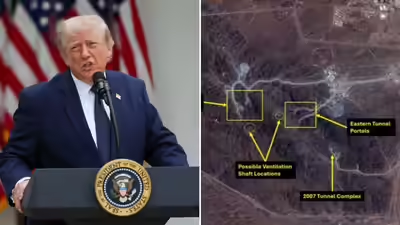
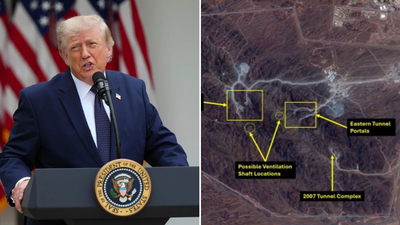
US President Donald Trump has signalled that Iran’s heavily fortified Pickaxe Mountain nuclear complex could be the next target of American strikes, describing it as a possible target for “a nice, big, fat shot right in the front door”. The remarks come as Washington intensifies military operations against Iran while keeping the door open to a negotiated settlement.Trump’s comments have once again drawn attention to one of the most secretive sites in Iran’s nuclear infrastructure. Buried deep beneath a mountain near the Natanz nuclear facility, Pickaxe Mountain has long been viewed by Western intelligence agencies as one of Iran’s most hardened nuclear-related installations. While Tehran insists it is meant for assembling advanced centrifuges, analysts believe it could eventually house uranium enrichment or even other sensitive nuclear activities.
Why Pickaxe Mountain matters
Known formally as Kuh-e Kolang Gaz La — “Kolang” translating to “Pickaxe” — the site lies just south-west of Iran’s Natanz enrichment facility. Construction of its newer tunnel complex began in 2020 after an above-ground centrifuge assembly plant at Natanz was destroyed.According to the Institute for Science and International Security, the complex consists of two pairs of tunnel entrances leading deep beneath the mountain. Satellite imagery suggests the underground halls are buried at least 100 metres below solid rock, while some analysts believe the site may contain multiple underground levels.Iran has consistently maintained that the facility is intended to manufacture advanced centrifuges. However, intelligence agencies and nuclear experts have suggested the mountain could also accommodate uranium enrichment facilities or other components of a future nuclear weapons programme, although no international inspectors have been granted access to verify what lies inside.
Why Washington sees it as a key target
Pickaxe Mountain escaped both the June 2025 Operation Midnight Hammer strikes and subsequent US-Israeli military operations this year.Trump said the US is closely monitoring the site through satellite surveillance and insisted there was currently little activity inside. Nevertheless, he indicated that the mountain remained firmly on Washington’s target list.Recent satellite imagery analysed by PBS Frontline and The Washington Post showed continued construction activity around the complex, including heavy equipment, expanding spoil piles and additional fortification of tunnel entrances. Those developments have fuelled concerns among Western analysts that Iran may be pushing parts of its nuclear programme deeper underground following attacks on more exposed facilities.Experts also argue that even if the site is not yet fully operational, allowing it to remain intact could enable Iran to rebuild elements of its nuclear infrastructure more quickly in the future.
Why is it so difficult to destroy?
According to TWZ, Pickaxe Mountain presents challenges unlike those posed by Fordow or Natanz.The underground chambers are believed to lie beyond the effective reach of America’s most powerful conventional bunker-busting weapon, the 30,000-pound GBU-57 Massive Ordnance Penetrator (MOP), which was specifically designed to attack deeply buried facilities. During Operation Midnight Hammer, multiple MOPs were used against carefully identified ventilation shafts at Fordow to maximise their effectiveness.No such vulnerabilities have been publicly identified at Pickaxe Mountain.Military analysts say simply striking the tunnel entrances would probably block access temporarily rather than destroy the underground complex itself. The Institute for Science and International Security notes that while some eastern entrances have already been partially obstructed by Iran, western entrances remain accessible. Those openings could potentially be targeted with precision-guided weapons, but that would likely only delay operations inside unless repeated strikes prevented repair work.Another complication is intelligence. Without detailed knowledge of the tunnel layout or ventilation systems, planners would struggle to identify the most vulnerable points beneath the mountain. Even advanced bunker-busting weapons rely heavily on accurate information about underground structures to achieve meaningful damage.