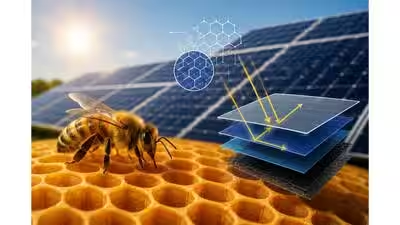
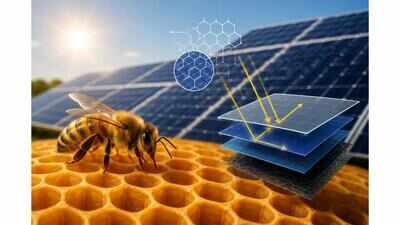
Bees may have helped solve one of solar energy’s biggest problems. According to a report by Ecoportal, engineers have developed a new type of solar panel using the honeycomb pattern that bees have mastered for millions of years. The idea is simple. Traditional solar panels lose a lot of sunlight when the sun is not directly overhead because the light bounces off the surface. The new honeycomb-inspired design traps more of that light instead of reflecting it. Early tests suggest the approach could significantly improve power generation while making solar panels more useful on a wider range of surfaces.
How bee honeycombs could make solar panels more efficient
One of the biggest challenges with today’s solar panels is that they work best only when sunlight falls directly on them. As the sun moves during the day, the light hits the panels at an angle. A large part of that light gets reflected instead of being turned into electricity.To fix this, engineers looked to nature for inspiration. They created a 3D concave solar panel based on the same hexagonal honeycomb structure built by bees. Instead of allowing sunlight to bounce away, the angled walls inside the structure make the light bounce from one surface to another. This gives the panel another chance to absorb the energy.
Tests show big gains in power outpuT
According to the researchers quoted in the report, the new design increased maximum power output by 142.3% compared with a conventional flat solar panel under the same conditions. Even when sunlight hit the panel straight on, power output improved by 36.4%. At a 60-degree angle, where traditional panels usually struggle the most, performance increased by 61.8%.The team also used a flexible 3D polymer metamaterial to support the honeycomb structure. This means the design could eventually be used on curved buildings, electric vehicles and even aerospace equipment, instead of being limited to flat rooftops.