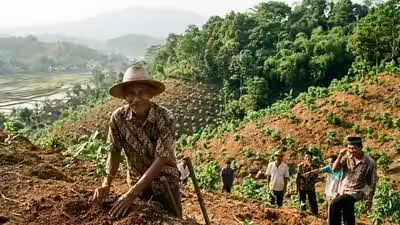
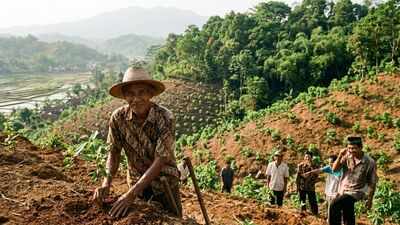
When traversing the hills of Wonogiri in Central Java, today’s visitors might take the dense areas of greenery in stride. The springs nourish nearby villages, the farms have sufficient water for numerous harvests, and the slopes covered with trees conceal the bare ground that used to be visible before. However, very few would think of the fact that many changes took place thanks to the commitment of one man who dedicated many years to tree-planting efforts despite the lack of encouragement from the people around him.Now well-known as an environmentally conscious individual, Sadiman began his mission with a straightforward realisation. As a person who noticed the depletion of the local forest due to the constant farming and the disappearance of streams that provided water for many villages, he came up with his own way to fight that trend. His solution was not a governmental initiative or a large-scale project of some kind; it was decades of planting one tree after another and getting mocked by his neighbours who did not understand the sense of growing useless plants.
How deforestation triggered Wonogiri’s drought and water crisis
The Wonogiri area has been known for many years to be dry. Rainfall is seasonal in nature, and the hilly nature of the area means that there is not much moisture retained after vegetation is destroyed in such areas. With the destruction of forests, cultivation and burning becoming common practices, the delicate balance that sustained the water supply of the area started dwindling away.People realised the negative impacts that had come about because of this. The rivers dried up, sources of water became inconsistent, and it became more difficult for people to carry out agricultural activities. In some cases, people could only farm during one cropping period because of lack of water.

How planting 11,000 banyan and ficus trees transformed Wonogiri’s hills
His attention settled on banyan and ficus trees, species known for their extensive root systems. Instead of growing only near villages or roads, he concentrated on higher ground where restoring vegetation could have a wider effect across surrounding catchment areas.As reported by Reuters in 2021, over more than two decades, he planted at least 11,000 trees across roughly 250 hectares (617 acres). The work progressed gradually. There was no sudden change to the landscape, only years of repeated planting and waiting for young trees to establish themselves.As the roots spread through the soil, they helped improve the ground’s ability to absorb and retain rainfall. The thicker vegetation also reduced erosion on exposed slopes, allowing water to filter underground instead of running quickly downhill after storms.
Why many villagers opposed Sadiman’s tree-planting mission
Many local residents questioned why anyone would spend so much effort planting banyan trees. Traditional beliefs surrounding the species meant some villagers associated them with spirits and avoided them altogether. Others simply saw little reason to exchange productive farmland or livestock for slow-growing trees whose benefits were far from immediate.Sadiman financed much of his work himself. Saplings became part of an unusual economy in which he traded or sold plants, including cloves and jackfruit, to support the continuing expansion of his nursery. At times he even exchanged livestock to obtain more young trees for planting.Some neighbours regarded these decisions as evidence that he had lost his judgement. The criticism continued for years, even as more hillsides slowly turned green.
How thousands of trees helped revive Wonogiri’s water supply
New springs were formed in areas which did not have any water source before, thus ensuring water source for the nearby community. The villages made use of pipes to get water directly into the households whereas the farmers got a more dependable water source for their agricultural purposes.For those families which were having a hard time due to lack of water, now they got water in a more convenient form. In addition, the farming was done two or three times a year as the source of water became more dependable.The trees kept on growing, thus perpetuating the process as they helped to conserve soil moisture.
Why villagers now celebrate the man they once called crazy
Public opinion changed only after visible results became impossible to ignore. People who had once questioned Sadiman’s choices began pointing to the healthier hillsides and restored water sources as evidence of what sustained reforestation could achieve. Local residents who remembered the criticism now acknowledge that the project has benefited several villages by supporting reliable supplies of clean water.The transformation did not happen through rapid engineering or large financial investment. It emerged through patient ecological recovery, with each planting season adding another layer to a landscape that had spent years deteriorating.