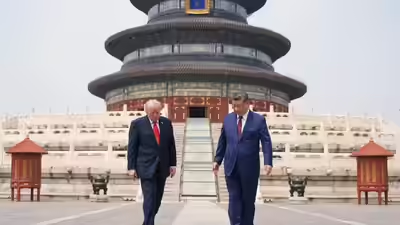
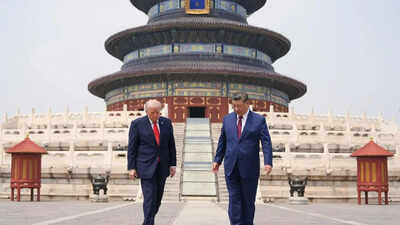
The TOI correspondent from Washington: US President Donald Trump is heading back from his high-stakes Beijing summit facing a storm of criticism at home that he effectively conceded geopolitical ground to a rising China, even as he touted commercial agreements and claimed he had stood firm on Taiwan.The visit, wrapped in elaborate ceremony but thin on substantive breakthroughs, underscored both the deep interdependence and growing mistrust between the world’s two largest powers. While Trump proclaimed great chemistry with Chinese President Xi Jinping and talked up four more meetings in 2026, many American analysts concluded that Beijing emerged with the greater strategic victory: international optics of equality with Washington and evidence that the US is increasingly constrained in confronting Chinese power.Some went further, describing the summit as America’s potential “Suez moment” – a reference to the 1956 Suez Crisis, when Britain and France discovered they were no longer capable of imposing their will globally without US support, marking the symbolic end of British imperial primacy. Critics now argue that Washington’s uneasy accommodation with Beijing reflects a similar transition toward a more multipolar order. And Trump’s own remarks aboard Air Force One added fuel to the debate.Speaking to reporters during the flight home, Trump disclosed that Taiwan figured prominently in his talks with the Chinese President. “Xi does not want to see a fight for independence,” Trump said. “I didn’t make a comment on it. I heard him out.” Asked about future US arms sales to Taiwan, Trump replied: “I will make a determination over the next fairly short period.”He further revealed that Xi had spoken emotionally about the island, saying China had possessed Taiwan “for thousands of years and then at a certain period of time it left and we’re going to get it back.” Trump insisted he made “no commitment either way,” but his refusal to explicitly reaffirm support for Taiwan alarmed many in Washington’s strategic community. The unease deepened when Trump remarked that “we don’t want to fight a war 9,500 miles away,” a line that even some conservative commentators interpreted as signaling reluctance to defend Taiwan militarily.The Taiwan issue remains the most explosive fault line in US-China relations. Beijing regards the self-governing island as a renegade province destined for reunification, by force if necessary, while Washington has long maintained “strategic ambiguity” – supporting Taiwan militarily without formally committing to war.Remarkably, Trump also acknowledged that tariffs – supposedly central to his economic confrontation with China – were “not brought up” during his discussions with Xi, surprising even supporters who had expected tougher bargaining. He further disclosed discussions on potentially easing sanctions affecting Chinese companies buying Iranian oil, another sign that Washington may be recalibrating pressure on Beijing amid broader geopolitical tensions.Despite administration claims of major commercial wins, details remained vague. Trump highlighted Chinese commitments to purchase 200+ Boeing aircraft, more American agricultural products, energy supplies and industrial goods, but there was no headline-grabbing structural trade accord or dramatic concession from Beijing.Equally striking was the carefully restrained reception Xi gave Trump. Gone was the theatrical warmth Trump often receives from foreign leaders (he had anticipated a “big hug” from Xi). Xi appeared formal, disciplined, and notably sparing in praise, projecting the image of a leader meeting an equal if not a supplicant. Chinese state media emphasized “mutual respect” and “stable coexistence” rather than personal chemistry.American mainstream media outlets interpreted the optics harshly. The Washington Post declared: “In pageantry and politics, China summit yields Xi’s goal – equal footing with US” Meanwhile The New York Times published an analysis headlined “China Increasingly Views Trump’s America as an Empire in Decline,” arguing that many Chinese, who once viewed America with “admiration, envy and resentment,” now see a chaotic and internally divided superpower losing strategic coherence.Liberal podcasts and anti-Trump commentators were even more brutal, with one widely circulated show describing the President as having been “dog-walked by Xi in a humiliating China summit.” Trump reacted furiously to criticism as he flew home, attacking CNN, NYT and its veteran correspondent David Sanger as “treasonous” for suggesting the administration had failed to achieve its objectives not only in China but also in Iran.Yet the most revealing symbol of the trip may have come not from summit communiques but from the departure tarmac in Beijing. As Air Force One prepared for takeoff, journalists observed US security officials collecting every item distributed by Chinese authorities to the American delegation and media – including credentials, pins and burner phones – and dumping them into bins at the foot of the aircraft stairs.“Nothing from China allowed on the plane,” one reporter posted on X, capturing the extraordinary distrust that persists beneath the carefully choreographed diplomacy.That mistrust extends into technology and security, areas where China is increasingly disdainful of the lead the US claims to have. The Americans acknowledged China still had not purchased Nvidia’s advanced H200 artificial-intelligence chips despite recent US approval for sales, reflecting China’s own confidence and Washington’s continuing anxiety over Chinese advances in AI and semiconductor capabilities.And in a characteristic twist blending geopolitics with spectacle, Trump ended the trip with a bizarre social media post praising China’s grand state architecture. “China has a Ballroom, and so should the USA!” he wrote, boasting about a new American ballroom project opening in 2028 and posting a photograph of himself walking beside Xi, whom he called “one of the World’s Great Leaders.”For allies across Asia – especially India, Japan, South Korea and Taiwan – the summit offered a complicated picture: a US President eager for transactional deals and personal rapport with Xi, but increasingly reluctant to define clear red lines in the Indo-Pacific’s central strategic contest. The result was a summit that may ultimately be remembered less for what Trump achieved than for what it revealed: a China confident enough to treat America as merely another great power, and America struggling to decide how much of its old dominance it is still willing – or able – to defend.