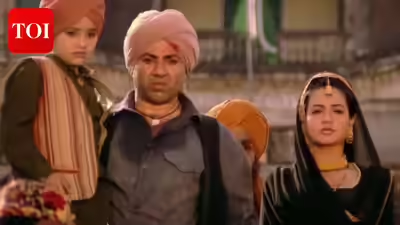
As Gadar: Ek Prem Katha marks 25 years since its release, actor Ameesha Patel has opened up about her initial concerns over being cast opposite Sunny Deol, revealing that she questioned whether the significant age difference between them was appropriate for the film.Ameesha was 26 years old when she starred as Sakina in the 2001 blockbuster, while Sunny Deol, who played Tara Singh, was 43 at the time. Looking back, the actor said she was never opposed to age-gap romances on screen, but believed such pairings should only exist when they are justified by the story.Speaking to India Today, Ameesha recalled wondering if the casting choice would resonate with audiences.“I had that fear. I wondered whether it was age-appropriate casting and whether it would fall flat,” she said. “My concern wasn’t because I was a newcomer. I would ask the same question even today.”She added, “Even as a newcomer, I’m glad I had those questions. I’m glad I had the foresight to ask whether it was age-appropriate, and I’m glad the subject justified it.”
‘Age gaps are fine if the story needs them’
The actor said Bollywood needs to continue examining age-gap romances, particularly when they are inserted into stories without a compelling narrative reason.“Age gaps are absolutely fine if the story needs them and justifies them. It needs to be questioned when stories don’t demand an age gap, yet one is inserted. That’s one of the reasons audiences aren’t accepting certain films today, to be very honest,” she said.Ameesha revealed that many people had advised her against taking up Gadar because the pairing with Sunny Deol appeared unconventional on paper.“I was given a lot of advice not to do the film because, on paper, it didn’t tick any of the boxes. Sunny was a superstar, but much older than me. People questioned how I could be paired opposite someone so much older,” she said.
Why Tara and Sakina’s relationship worked
Despite the concerns, Ameesha believes the age gap between Tara Singh and Sakina was essential to the narrative and added depth to their love story.“The subject required the age gap. It was a love story of an already established working man who falls in love with a girl when she’s only in a convent school,” she explained.According to the actor, Tara perceived Sakina as someone completely beyond his reach.“He thought she was unattainable for many reasons—age, social status, education, and religion. Everything about Sakina seemed beyond Tara’s reach. For him, she was a queen he could never have. A princess he could never attain,” she said.Ameesha further reflected on the emotional core of the film, saying the relationship between the two characters transcended religious and social barriers.“And that’s the beauty of Gadar. She adapted beautifully to his Hindu culture and his family. At the same time, when push came to shove, and he had to save the love of his life, he was willing to settle in Pakistan. In the mosque, in front of everyone, he makes that declaration. He only becomes furious when he is asked to renounce his identity,” she said.She added, “So it is a deep love story—one of passion and genuine love. It shows that Hindus and Muslims can coexist. The cross-border rivalry and hatred are often politically driven. In reality, people across the border have always shared deep human connections.”
‘Gadar was an underdog film’
Reflecting on the film’s journey, Ameesha described Gadar as an underdog project that very few people in the industry believed would succeed.“Gadar was an underdog film that nobody had faith in except the people involved in it. Everybody did it with their hearts and souls. They worked extremely hard, with dedication, sincerity, and conviction,” she said.The actor also credited producer Nitin Keni for recognising her potential even before she became a star. She revealed that Kaho Naa… Pyaar Hai had not yet been released when he approached her for Gadar after seeing one of her magazine photoshoots.Despite widespread scepticism, Ameesha said audiences ultimately proved the doubters wrong and turned the film into one of the biggest blockbusters in Hindi cinema history.“There are many films that look great on paper, but when they are released, the box office tells a different story. At the end of the day, the audience is king. The king accepted the film, and that’s what mattered,” she said.