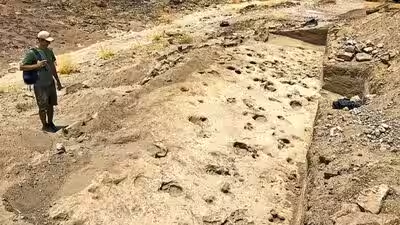
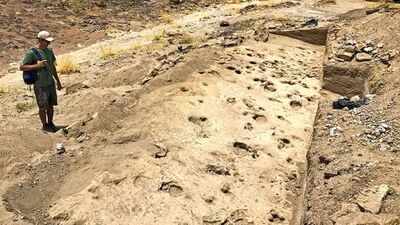
Long before stone tools or bones tell their part of the story, footprints can preserve something far more immediate. They capture movement rather than anatomy, recording where an individual walked, how they placed their feet, and sometimes who was travelling beside them. A newly described set of fossil footprints from northern Kenya offers a rare glimpse into the lives of Early Pleistocene hominins around 1.43 million years ago. Preserved along what was once a lakeshore, the tracks suggest that several large-bodied individuals crossed the same muddy ground together. While the identity of the track-makers remains open to debate, the footprints provide fresh evidence about body size, walking style and the social behaviour of one of humanity’s ancient relatives.
Where the 1.43-million-year-old fossil footprints were found in Kenya
The footprints were uncovered within Kenya’s Koobi Fora Formation, an area already well known for producing fossils belonging to both the genus Homo and Paranthropus. Unlike skeletal remains, which are often scattered or incomplete, this single footprint surface captures a brief moment when several individuals walked across soft sediment bordering an ancient lake. According to the study published in the Proceedings of the National Academy of Sciences, titled “Insights into hominin body size, locomotion, and behaviour from Early Pleistocene trackways in northern Kenya”, the impressions date to roughly 1.43 million years ago and formed in a deltaic lakeshore environment. The setting suggests these hominins were moving through a habitat where water, vegetation and food resources would have been concentrated, rather than crossing open, dry ground.
Ancient footprints raise new questions about Homo erectus and Paranthropus boisei
The shape of the footprints has become one of the study’s most intriguing findings. Certain internal features resemble older fossil tracks that have previously been linked to Paranthropus boisei. Those earlier footprints suggested a pattern of walking and foot anatomy that differed from modern humans and retained similarities with even earlier australopithecine relatives.As per the study, at the same time, the newly discovered tracks appear to belong to individuals much larger than expected for P. boisei. That creates an unusual puzzle. If the footprints were indeed left by Paranthropus, it would mean the species reached body sizes beyond those indicated by its known skeletons. If they instead belong to Homo erectus, then the species may have shown far greater variation in foot structure and walking mechanics than fossil evidence has previously revealed.The researchers do not argue that either possibility has been settled. Instead, they present both interpretations while recognising that each would reshape current ideas about these Early Pleistocene hominins.
Ancient Kenya footprints reveal larger-than-expected early human relatives
Footprints cannot measure height directly, yet they provide valuable clues when analysed alongside experimental data and modern human comparisons. By examining footprint dimensions, stride characteristics and trackway patterns, the team estimated that several individuals responsible for the tracks were considerably large-bodied.Those estimates exceed the largest skeletal reconstructions currently available for Paranthropus boisei. Even without assigning the footprints to a particular species, the evidence points towards a group containing individuals substantially larger than the average expected from the existing fossil record.According to the study, the larger body sizes recorded in multiple trackways support the possibility that several adult males were present within the same group, offering an uncommon opportunity to infer aspects of social organisation from preserved behaviour rather than bones alone.
Fossil footprints reveal how early human relatives may have lived in groups
Bones can reveal how an ancient individual was built, but footprints sometimes reveal what they were doing. Several trackways on the excavated surface appear to have been produced over a relatively short period, suggesting that multiple hominins crossed the lakeshore while travelling together or moving through the same area in close succession.The authors suggest that the collection of tracks may represent a social group that included several adult males. Such direct behavioural evidence is exceptionally uncommon in the fossil record because it depends on a precise combination of environmental conditions: soft ground capable of recording footprints, followed by rapid burial and preservation over more than a million years.As stated in the PNAS study, the footprints provide “rare direct evidence” for aspects of hominin social behaviour that skeletal fossils alone cannot easily capture.
Kenya’s ancient footprints reveal a rare glimpse into early human life
The discovery does not settle the long-standing question of which hominin species produced these footprints. Both Homo erectus and Paranthropus boisei lived in the region during the Early Pleistocene, and both remain plausible candidates based on the available evidence.What the footprints clearly demonstrate is that body size, locomotion and behaviour may have been more varied than previously recognised. They also reinforce the idea that ancient lakeshores were shared landscapes where different hominin species likely occupied overlapping environments over extended periods.Rather than replacing skeletal evidence, the Kenyan trackways add another layer to it. Each footprint records a single step, but together they preserve a brief episode from 1.43 million years ago that bones alone could never reconstruct.