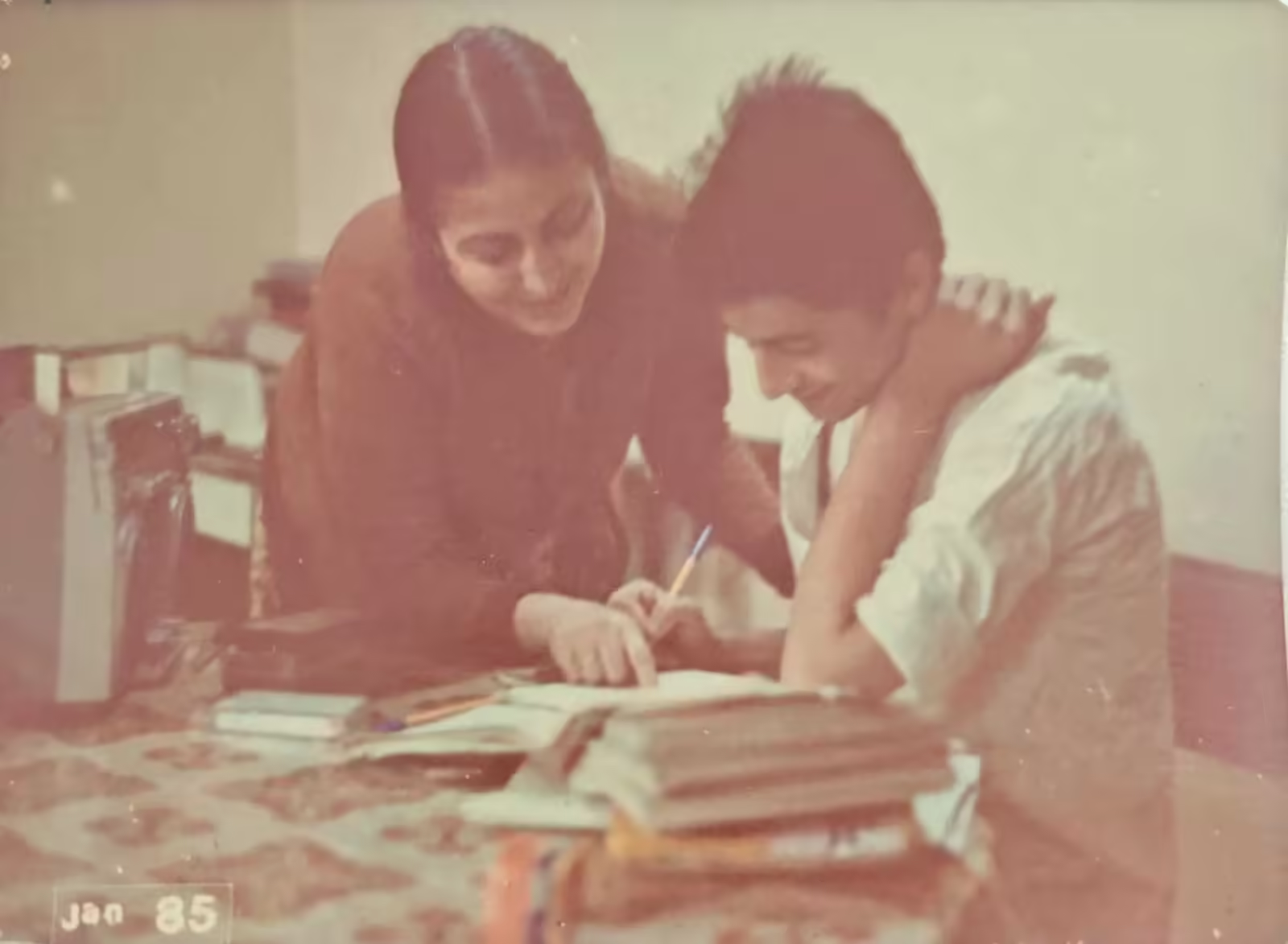
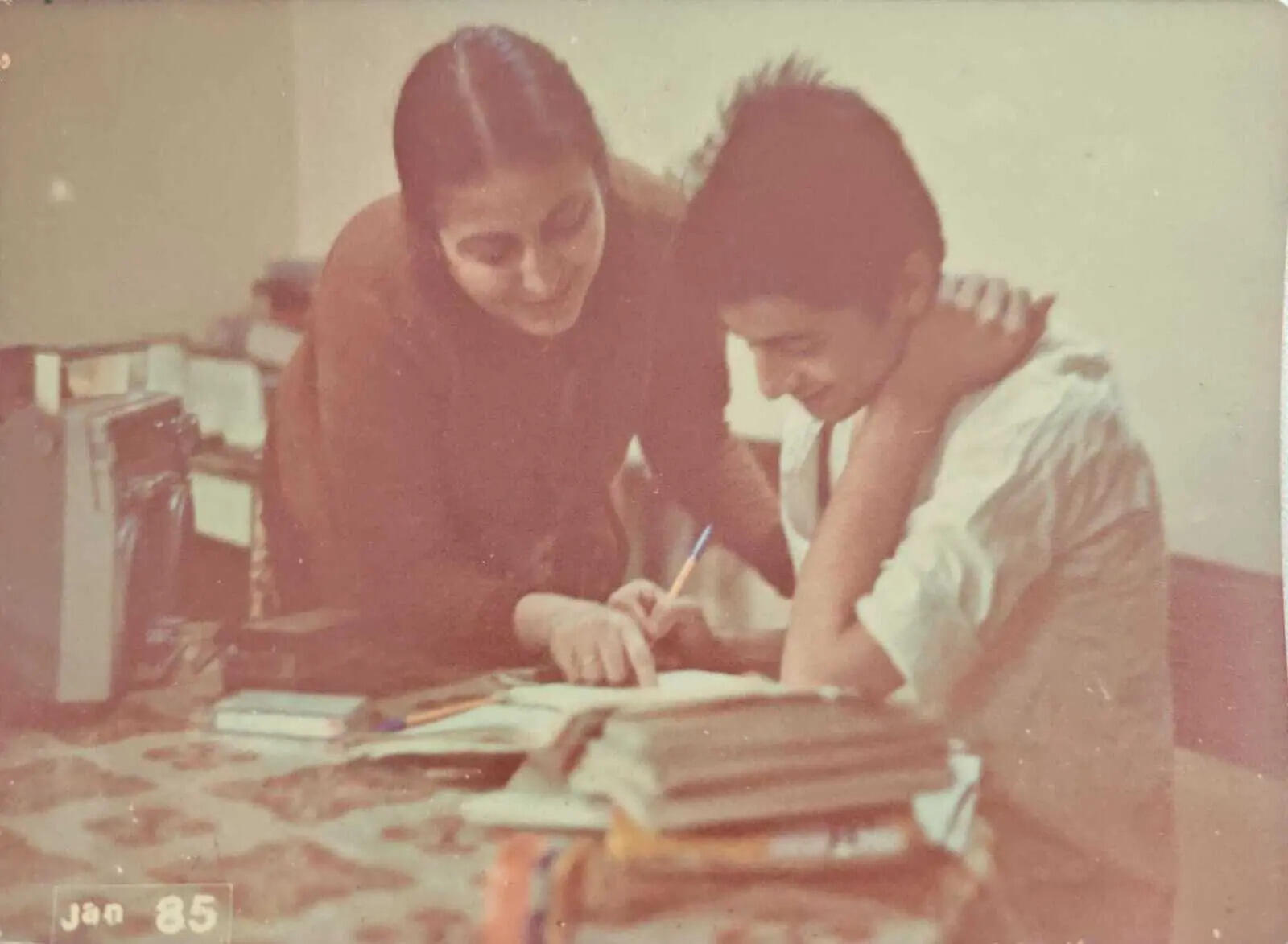
Family pictures before mother’s death
Mahliqa Qarai first studied mathematics at Osmania University before later completing an MA in English Literature at AMU after marriage and motherhood while continuing to work on translations and publications linked to Islamic philosophy and Persian intellectual traditions. Her brother, Ali Quli Qarai, now based in Qom, also later emerged as one of the most respected translators of Islamic texts in the Persian-speaking world.Waheed’s father, Prof. Waheed Akhtar—the towering Urdu poet-philosopher credited with reviving the classical marsiya (elegy) tradition in the 20th century—was among the most influential literary and intellectual voices of his era. Born in Aurangabad, he spent nearly four decades at AMU, eventually serving as Dean of the Faculty of Arts and Chairman of the Department of Philosophy.The family spent years closely connected to Iran during and after the revolution. Waheed remembers Tehran in the 1980s as intellectually alive but psychologically exhausted by war.“Everything came through coupons. Eggs, food, essentials,” now a regular Iran visitor, he recalled from his early visits. “People stood in queues all the time. There were funerals constantly. Yet people still discussed poetry, philosophy and literature.”Even amid destruction, he said, people clung to dignity and ideas.“The Iranian people wanted peace,” he said. “Even in harsh conditions, they wanted education, literature and dignity.”The war years also shaped his understanding of West Asia’s politics. “It is such a resource-rich and civilisationally rich region,” he said. “But those very things became a curse instead of a blessing.”Nothing scarred the family more deeply than the loss of his mother. “My father was never the same after that,” Waheed said quietly.Prof. Akhtar was 54 when his wife died. Friends and admirers across India and Pakistan watched the prolific Urdu scholar slowly withdraw into grief and silence.“In the years after her death, he hardly wrote,” Waheed said. “He was surrounded by books, but something inside him had collapsed.”The emotional devastation soon became physical. His health deteriorated steadily through heart and kidney complications. “The stress consumed him,” Waheed said. “He never really recovered.”Prof. Akhtar died in 1996.For Waheed, that is the part of war the world often forgets.“After some time, people stop seeing names and faces,” he said. “They only see numbers.”Yet amid the grief, the family’s relationship with AMU has continued across generations. In May this year, the family helped establish a state-of-the-art Artificial Intelligence laboratory at AMU’s Zakir Husain College of Engineering and Technology, focused on ethical AI research and future technologies.“Our family moved through literature, philosophy, politics and now technology,” Waheed said. “Maybe continuing to build institutions, ideas and knowledge is also a way of surviving loss.”“When people watch war on television today, they think destruction is temporary,” he said. “It isn’t. For some families, like ours, it becomes a permanent memory.”