A major challenge facing armed forces around the world is the rapid proliferation of drones on modern battlefields. Both Russia and Ukraine are currently engaged in fighting thousands of drones that have become ubiquitous along the frontlines. At the same time, countries across the Persian Gulf are grappling with the threat posed by Iranian drones targeting critical infrastructure, using them as a relatively inexpensive alternative to cruise missiles. India too faced this challenge, destroying around 600 Pakistani drones launched in an attempt to overwhelm Indian air defences.One of the factors that has amplified the effectiveness of these systems is that, until recently, air defence networks were designed primarily to counter high-value threats such as fighter aircraft, cruise missiles and, to a lesser extent, ballistic missiles. Air defence systems evolved in complexity—and consequently cost—to defeat increasingly sophisticated targets. The emergence of cheap drones has disrupted this paradigm. Destroying a Shahed, Geran or India’s own Sheshnag drone is not particularly difficult. In fact, air defence crews have for decades trained against inexpensive aerial targets that perform similarly. The challenge lies in the economics: an inexpensive drone being engaged by a missile system designed to intercept ballistic missiles. The comparison of a $20,000 drone versus a million-dollar interceptor has become a defining feature of modern air warfare.The solution lies in affordable systems capable of defeating this new scourge of the battlefield while also engaging large numbers of drones. Many existing and relatively inexpensive weapons are now being repurposed for this role. Among the most effective are air defence guns. India successfully employed upgraded L-70 and Zu-23 guns against Pakistani drones, destroying many of these aerial threats at relatively low cost. Elsewhere, lasers and electronic warfare systems that jam drone control frequencies are increasingly being deployed to counter unmanned systems.
Rocket power for anti-drone operations
Another weapon being adapted for this mission is the guided rocket, which can be launched from both ground and air platforms. Smart rockets are rapidly redefining the economics of precision warfare. Once dismissed as “dumb” saturation weapons, unguided rockets are now being transformed into cost-effective precision strike systems through the addition of guidance kits. Their effectiveness has already been demonstrated in West Asia, where aircraft and attack helicopters have used guided rockets to shoot down Iranian Shahed drones.The Advanced Precision Kill Weapon System (APKWS), a laser guidance kit fitted to the legacy Hydra 70 unguided rocket, bridges the gap between the inexpensive Hydra rocket and the more costly AGM-114 Hellfire missile for ground targets, as well as the even more expensive Sidewinder missile for aerial threats. The upgraded APKWS II, designated AGR-19/20/21, is also used against lightly armoured ground targets. The system has been widely deployed by the United States during operations against Iran. It is integrated on aircraft including the F-16, F/A-18, A-10 Thunderbolt II, F-15 and the Eurofighter Typhoon.Europe has also embraced the concept through the FZ275 Laser Guided Rocket (LGR), developed by Forges de Zeebrugge, now part of Thales Belgium. India has entered this space as well, with Adani Defence & Aerospace signing an agreement in June 2024 to domestically produce precision guidance kits for attack helicopters such as the HAL Rudra and Prachand, both of which already employ 70mm rockets.The Indian Air Force is now seeking to build on this capability through an indigenous solution. In its recently released document Sankalp 2026, the IAF has sought a new warhead for the 70mm rockets fired by Rudra and Prachand helicopters. The warhead is specifically designed to destroy unmanned aerial systems, including micro and mini drones. The Air Force has specified a 900-gram warhead with a 25-metre blast radius, making it particularly effective against swarm drones. It also wants laser-guided variants of the rocket.Indigenous innovation has already made progress in this area. IIT Madras and Bharat Electronics Limited (BEL) have jointly developed an 80mm rocket guidance kit with a range of 10 km. Eighty-millimetre rockets are already in service with the IAF on Mi-17 and Mi-35 helicopters, and a laser-guided variant is planned to improve their precision strike capability. In May, the Indian Navy issued an Expression of Interest (EoI) seeking domestically designed and manufactured 80mm rockets. Russia’s Ugroza system is similarly converting older S-5, S-8 and S-13 rockets into guided munitions, many of which are also in Indian service. Comparable developments are underway in China, South Korea and Turkey.
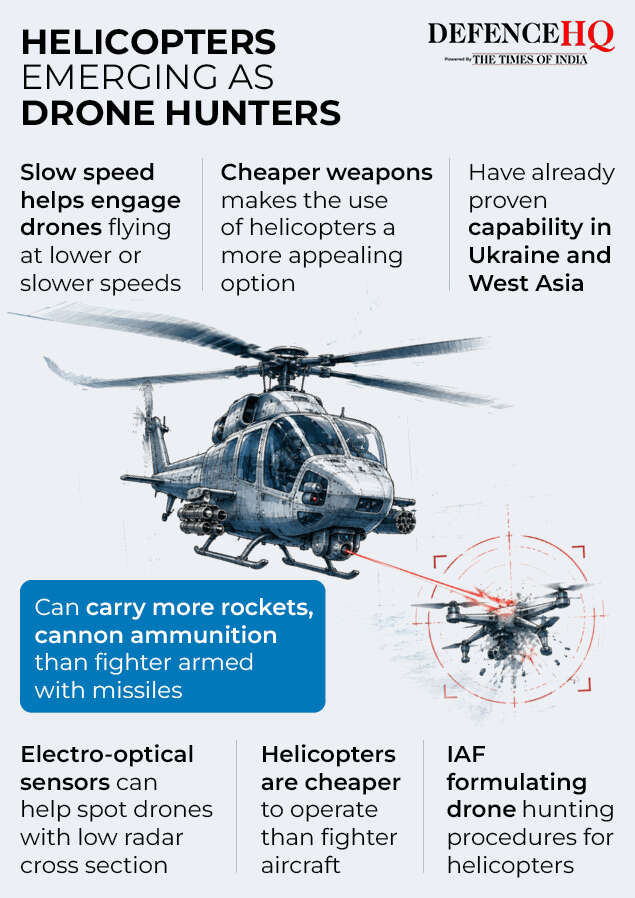
Helicopters are taking an increasingly important role in hunting drones.
Helicopters: the new drone slayers
Helicopters are versatile flying machines that are better suited for drone hunting than fighters. Their low operating cost, more eyes in the cockpit, ability to fly low and slow as well as the use of lower cost weapons makes them effective in this role.
Group Captain Ajay Ahlawat (retired)
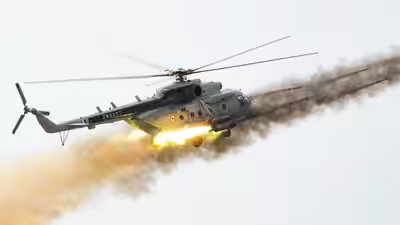
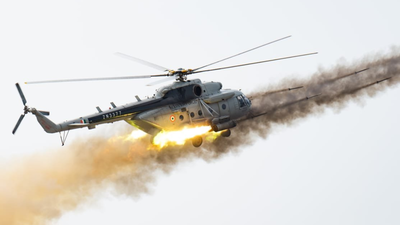
Helicopters are increasingly being viewed as ideal platforms for counter-drone operations. These unmanned systems fly low and slow, often operating in the same flight envelope as helicopters. Over Ukraine, both helicopters and slow-moving trainer aircraft are being used to intercept Russian Geran drones, an improved variant of the Iranian Shahed. Shahed-class drones cruise at around 200 kmph, a speed at which most helicopters can operate comfortably. This allows a helicopter to maintain a stable position relative to the drone and achieve a firing solution using guns, rockets or missiles.Most fighter aircraft, by comparison, have stall speeds well above 200 kmph. The F/A-18, for instance, is renowned for its low-speed handling, yet has a stall speed of around 130 knots, or approximately 240 kmph. As a result, a fighter would need to continuously circle around a drone at the limits of its flight envelope until the target is destroyed. Operating in such a regime also increases risk, potentially leading to the loss of both aircraft and pilot.Another advantage of helicopters is that they are runway-independent, allowing them to be deployed close to likely drone ingress routes. Most modern military and attack helicopters are equipped with advanced electro-optical sensors and thermal imagers that can detect small drones, which are often difficult for radar to track.Given India’s diverse and rugged terrain—from the dense rainforests of the Northeast and the towering Himalayas to the deserts of the west—the armed forces have already deployed helicopters extensively across border regions. This ensures that these aircraft are readily available in forward areas where drone incursions are most likely.The Indian Air Force recently concluded Exercise Rotor Clap-III, a counter-Unmanned Aerial System exercise designed to evaluate different methods of defeating aerial threats. According to an IAF source, the exercise also included targeting enemy ground control stations. The objective was to formulate tactics, techniques and procedures for counter-drone operations.
There are challenges for helicopters when it comes to intercepting drones. Helicopter operations are restricted in bad weather and low visibility conditions. Their slow speed can limits their drone intercept ability in certain scenarios. It would also be difficult for a helicopter to engage a maneuvering drone and drone swarms.
Group Captain Ajay Ahlawat (retired)
Helicopters are increasingly proving themselves to be highly effective drone killers. Equipped with dedicated counter-drone weapons, these aircraft, which have already cemented their role in modern warfare, are now expanding their utility to tackle one of the defining threats of contemporary combat. Long regarded as one of the greatest threats to tanks, helicopters now appear well on their way to becoming one of the most credible counters to the growing menace of drones.