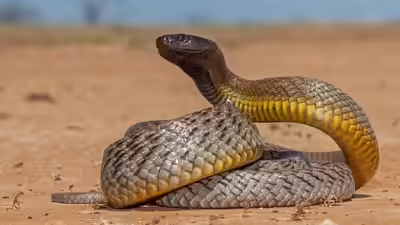
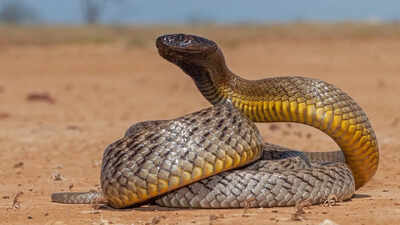
The Inland Taipan, which is known by the name “fierce snake” has an elongated and slender body that grows to about two metres long. It has an elegant structure, including a small head that is barely noticeable compared to the rest of its body. Notable for its seasonal variation, during winter its head and dorsal surfaces turn dark brown to nearly black; during summer, however, its body turns olive to tan. The ventral side appears pale with a cream or yellow hue, sometimes marked with brown or orange patches. It has tiny, shiny scales.
Head characteristics and markings
Its head is long but narrow, unlike those of many other venomous snakes. Its eyes are comparatively small, and it has no prominent stripes or patterns on its head. As such, the lack of distinctive markings on its head often makes it hard to distinguish it from similar brown snakes.Beehive in your garden? Safe removal, natural repellents and eco-friendly control tips that workHow to identify a Copperhead snake in your home and gardenWhat attracts snakes to your home and garden
Behavior and temperament
Contrary to popular belief, the inland taipan is highly shy and elusive. This snake does not come into frequent contact with humans and avoids conflicts. In case of an encounter, it prefers to flee rather than fight.Best ways to mole- and rat-proof your home and gardenAlso read: How to identify a Cobra snake (without getting too close)Best ways to snake-proof your home and garden
Habitat and geographical information
Another essential aspect in recognizing the inland taipan is its habitat. This snake is endemic to the arid parts of Australia, especially areas characterized by cracking clay soils and low vegetation cover. It commonly resides in deep soil cracks or abandoned animal burrows. One must consider its geographical distribution; hence, any sighting of a similar snake in other countries cannot be the inland taipan.
Scientific research and findings
Scientific papers, including publications in Toxicon, have revealed that the inland taipan is a highly venomous animal, with its venom comprising neurotoxins and factors that impair coagulation. The action of the toxins is very fast, inducing paralysis and producing a strong effect on the organism of the prey. In addition, new studies have indicated the symptoms associated with envenomation, including coagulopathy and neuromuscular paralysis. Another discovery concerns the evolution of the venom of the inland taipan which has evolved for efficient paralysing fast-moving prey, such as rats.According to a study by Billa Bong Sanctuary, the most reliable way to identify most snakes is by counting the rows of scales across the back at mid-body and examining the scale patterns on the head and tail. While a few species have distinctly recognizable body shapes and some unique scale arrangements, colour alone is generally not a dependable feature, as it can vary significantly.In order to identify the inland taipan one needs to be aware of certain characteristics of the animal, which include slender body shape, small smooth scales, season-specific colouring, a slim head, the presence of no specific patterns on the head and a strictly limited area of residence which does not exceed Australian regions. Nonetheless, as the animal resembles other brown snakes, the accurate identification might require special skills.In conclusion, identifying the Inland Taipan comes down to recognizing its subtle color changes, remote arid habitat, and slender, fast-moving build, key traits that set this highly venomous yet rarely encountered snake apart from others.