India will not enter into the proposed bilateral trade agreement with the United States until a framework ensuring a comparative tariff advantage for Indian exports over competing countries is finalised, Commerce minister Piyush Goyal said on Thursday.“Discussions with Washington are now focused on creating a framework that gives India a competitive edge over peers”, news agency Reuters quoted Goyal as saying.“We cannot enter a deal with the US until the framework of having a comparative advantage is finalised,” Goyal said, adding “India and the United States are very close to finalising a trade deal”.The minister said India and the US had agreed on the broad contours of the trade pact on February 6, and negotiating teams from both countries have been working since then on the finer details.“And until the framework of getting that competitive advantage can be finalised, we can’t enter into force a US deal. I don’t think I can be more transparent than that…So that’s broadly the discussions (between India and the US) on how the US will find the appropriate tools and legal backing to give us that competitive advantage over our competitors,” he added.When the framework of the first phase of the BTA was finalised, India had a comparative advantage over its competitor countries, such as ASEAN nations (Indonesia, Malaysia, Singapore, Thailand, Philippines, Brunei, Vietnam, Laos, Myanmar, Cambodia), Sri Lanka, Pakistan and Bangladesh.The minister added that the framework or contours of the agreement with the US was finalised and announced on February 6 this year and both the teams are working since then to finalise the fineprint.“There is always a little give and take (in an agreement),” PTI quoted Goyal as saying.“The whole deal was centred around that competitive advantage that we got with 18 per cent over our neighbours and competing countries. So we were lower than all our neighbouring countries, lower than all Asean countries other than Singapore, that is why the deal was attractive for us,” he said.“With the US Supreme Court striking down Trump’s sweeping tariffs and now with the additional temporary levy getting expired on July 24, “we obviously have to have some reason to be able to enter into force that agreement that we have already agreed upon,” Goyal said.Goyal added that discussions are underway on the legal and policy mechanisms through which Washington can provide India with that competitive advantage.“Discussions are on about how US finds appropriate tools and legal backing to give India a competitive advantage,” he said.
Review meeting
Earlier on Wednesday, India and the United States reviewed progress on the proposed interim bilateral trade agreement (BTA) during two days of ministerial-level talks, discussing issues ranging from market access and digital trade to non-tariff barriers, but stopped short of indicating that all outstanding differences had been resolved ahead of a key US tariff deadline next month.Piyush Goyal and visiting US Trade Representative Jamieson Greer held discussions on the first phase of the proposed trade pact, which both countries have been negotiating since agreeing on a broad framework earlier this year.
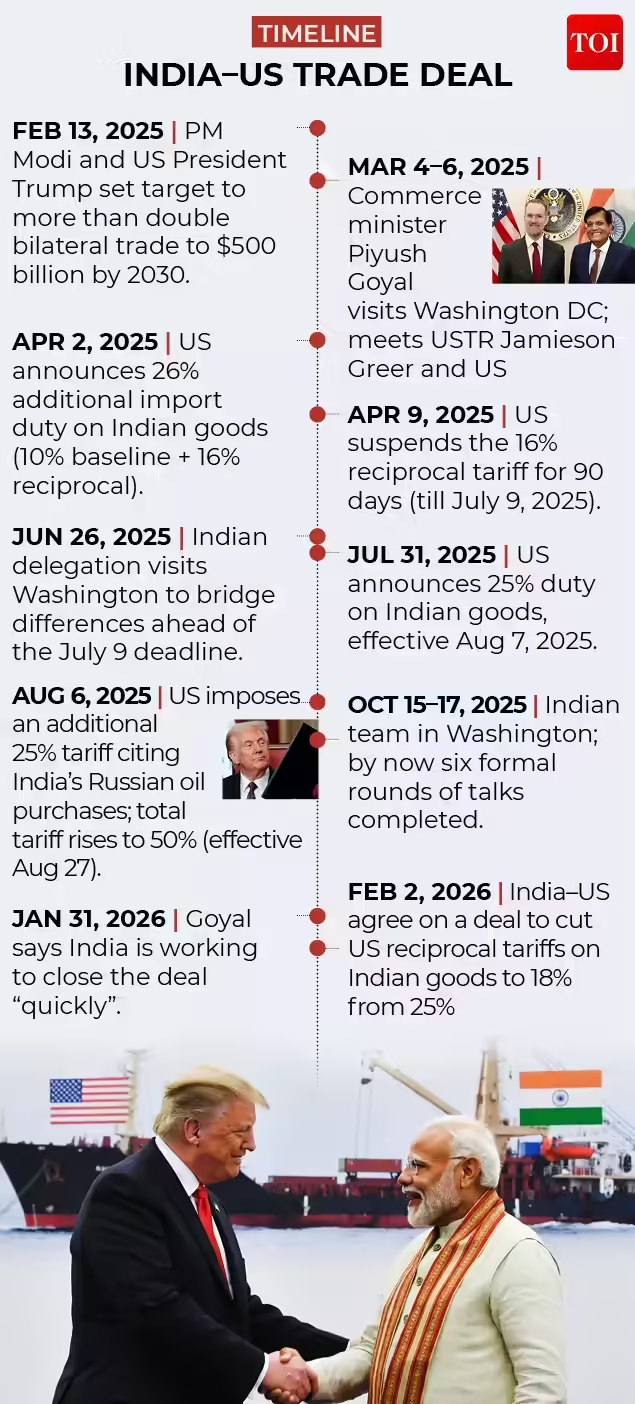
India-US trade deal timeline
In a statement issued after the talks, the Commerce ministry said the two ministers carried out a “comprehensive review” of the proposed agreement, covering enhanced market access, digital trade, resilient supply chains, reduction of non-tariff barriers and cooperation in strategic sectors.The ministry said both sides discussed pathways to conclude an interim agreement and reaffirmed their commitment to a pact that is “balanced and commercially meaningful”.While describing the negotiations as making “substantial” progress, neither side indicated whether all contentious issues had been resolved.“Discussions focused on pathways to conclude an interim agreement as an important milestone toward a comprehensive BTA,” the ministry said.It added that the two ministers reaffirmed their commitment to a trade agreement that is “balanced, commercially meaningful, and delivers tangible benefits for businesses, farmers, workers, and consumers in both countries”.“Recognizing the growing significance of the India-US economic partnership amid evolving global trade dynamics, both sides reiterated their shared goal of expanding bilateral trade, fostering innovation, and building resilient, trusted supply chains,” it said.
Race against July 24 tariff deadline
Greer’s June 22-24 visit comes as New Delhi and Washington attempt to conclude an interim agreement before the expiry of the US’ temporary 10% tariff regime on July 24.The ministerial meeting followed chief negotiator-level discussions held in New Delhi earlier this month between June 2 and 4.The two countries formally launched negotiations for the bilateral trade agreement on February 13, 2025, after announcing the contours of the first phase a week earlier.
Why tariff advantage has become India’s key demand
A central objective for India is to secure preferential tariff treatment over competing exporters such as Vietnam and other ASEAN economies.Under the February 7 framework, the US had agreed to reduce tariffs on Indian goods to 18% from 25%, giving India an advantage over several competing exporting countries.
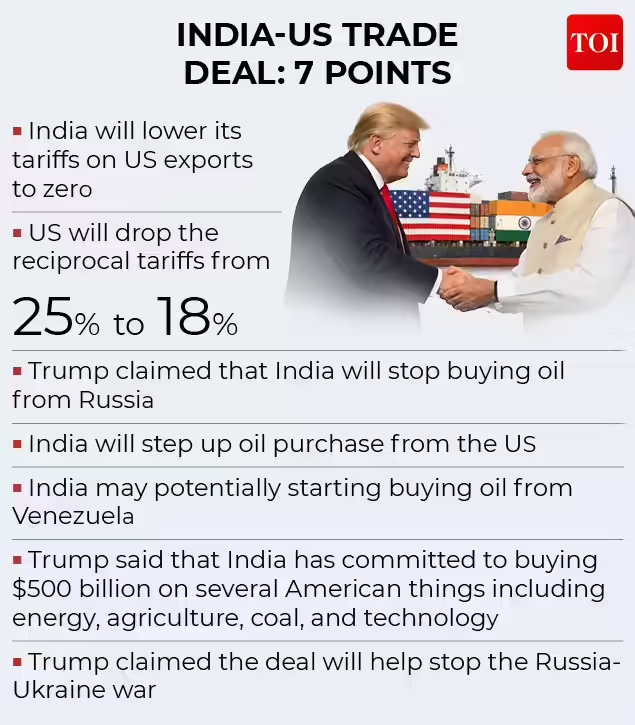
India-US trade deal top points
However, that framework was disrupted after the US Supreme Court struck down President Donald Trump’s sweeping tariff regime on February 20.The ruling prompted Washington to impose a temporary 10% tariff on imports from all countries for 150 days under Section 122 of the Trade Act, effective February 24. The temporary arrangement expires on July 24, forcing both countries to revisit key elements of the proposed agreement.The original framework also contains a clause allowing either side to modify its commitments if agreed tariff levels change.
Section 301 investigations
To retain negotiating leverage, the Office of the US Trade Representative launched two Section 301 investigations in March covering around 60 economies, including India.One probe examines alleged excess industrial capacity, while the other focuses on forced labour concerns in global supply chains.After the temporary tariff expires, Section 301 investigations are expected to remain Washington’s primary legal mechanism for imposing tariffs on trading partners, including India.
What India has offered
Under the proposed framework, India has offered to eliminate or reduce tariffs on all US industrial goods and a wide range of agricultural products, including dried distillers’ grains (DDGs), red sorghum for animal feed, tree nuts, fresh and processed fruits, soybean oil, wine and spirits.New Delhi has also indicated its willingness to purchase USD 500 billion worth of US energy products, aircraft and aircraft parts, precious metals, technology products and coking coal over the next five years.The US remained India’s second-largest trading partner in 2025-26.India’s exports to the US rose 0.92% to USD 87.3 billion during the last fiscal despite higher tariffs, while imports increased 15.95% to USD 52.9 billion. India’s trade surplus narrowed to USD 34.4 billion from USD 40.89 billion in the previous fiscal, according to official data.