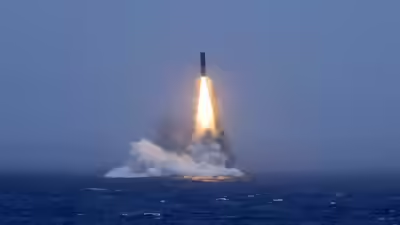
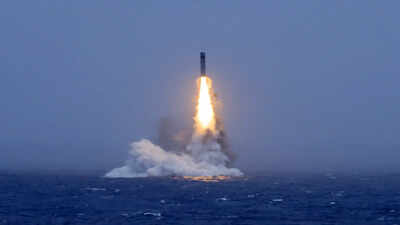
China’s first publicly known submarine-launched ballistic missile test in more than four decades has raised fresh concerns about Beijing’s rapidly expanding nuclear capabilities and its growing military assertiveness in the Indo-Pacific. Defence analysts say the launch was not merely a weapons test but a strategic signal aimed at demonstrating that China now possesses a credible sea-based nuclear deterrent capable of surviving an enemy’s first strike.The test is also expected to strengthen calls in the United States and among its regional allies, particularly Japan, Australia and New Zealand, for closer security coordination and higher defence spending as China’s military modernisation accelerates. China launched a ballistic missile from a nuclear-powered submarine into the Pacific Ocean on Monday, marking its first known submarine-launched ballistic missile test since 1982.The launch showcased the operational readiness of China’s sea-based nuclear force, which forms one leg of the country’s nuclear triad alongside land-based missiles and air-delivered nuclear weapons. A sea-based deterrent is widely regarded as the most survivable component of a country’s nuclear arsenal because submarines are far harder to detect and destroy.“This missile test appears to have been intended more for strategic signalling than for technical experimentation or operational development,” said Zhao Tong, a senior fellow at the Carnegie Endowment for International Peace.“Although China has long been understood to possess this capability, this marks its first public demonstration.”
What happened during the launch
China confirmed the launch and informed several countries, including Australia, Japan and New Zealand, in advance. However, Beijing did not disclose which missile was fired, where exactly the submarine launched it from or the route it followed.Ankit Panda, the Stanton senior fellow in the Nuclear Policy Programme at the Carnegie Endowment for International Peace, told South China Morning Post that the missile “likely took place from the South China Sea” rather than the Bohai Sea, as some observers had suggested.Ahead of the launch, China issued two navigation warnings covering areas where rocket debris could fall. Japan later confirmed that while it had been notified in advance, the missile neither entered Japanese airspace nor landed inside its Exclusive Economic Zone.Chinese military analysts, quoted by state broadcaster CCTV, said the missile was most likely the JL-3 submarine-launched ballistic missile, which has a range exceeding 10,000 kilometres.Military expert Zhang Junshe said this assessment was “based on images from the scene and the official announcement”. He added that the missile may have been launched from a Type 094 ballistic missile submarine or a newer strategic submarine currently under development.China currently operates at least six Type 094 Jin-class ballistic missile submarines and is believed to be developing the more advanced Type 096 class as part of its expanding nuclear fleet.Taiwan’s former foreign minister Joseph Wu claimed on social media that China had launched a JL-2 missile that flew over the Philippines, calling the launch “a provocation that destabilises the Indo-Pacific”.Michael Bosack, founder of the Parley Policy Initiative and a former US-Japan alliance manager, said it remained difficult to determine whether the missile was a JL-2 or JL-3 because the latter may not have been tested over its maximum range.“It would have been much more significant if the Chinese launched from an open-water location into the South Pacific,” he said.“That tells me there is still some research and development going into these systems that require them to operate closer to shore.”Zhao said the launch nevertheless reflected China’s entry into “a new phase” of expanding its ballistic missile submarine fleet and strengthening its undersea nuclear strike capability.
US and regional allies voice concern
The United States reacted more sharply than it had after China’s 2024 intercontinental ballistic missile test, reflecting growing concern over Beijing’s expanding nuclear arsenal.US State Department spokesman Thomas Pigott said China’s “rapid and opaque nuclear weapons build-up” remained “of great concern” to both the region and the wider international community.Former PLA colonel Yue Gang said the launch demonstrated that China’s submarine-based nuclear force had reached a high level of operational maturity while sending a strategic signal to both Washington and Tokyo.“If the launch took place from the Bohai Sea, the missile’s debris would have landed near Japan’s doorstep, making it a calculated signal intended to unsettle and warn Tokyo,” he said.Zhao also suggested that the timing of the launch may have carried historical symbolism.“The launch also took place one day before the anniversary of the Marco Polo Bridge incident on July 7, 1937, which marked the beginning of China’s full-scale War of Resistance against Japanese Aggression, adding another layer of symbolic significance,” he said. Japan said it had “serious concerns” about China’s “expanding and intensifying” military activities.Australian Foreign Minister Penny Wong described the launch as “destabilising”, while New Zealand Foreign Minister Winston Peters said his country was “deeply concerned”.Malcolm Davis, a senior defence analyst at the Australian Strategic Policy Institute, said the timing of the launch was also significant.“Clearly this was a message from Beijing, to Australia and to Fiji and to other southwest Pacific states, that China will assert its power including through threat of use of force,” he said.Responding to the criticism, Chinese foreign ministry spokeswoman Mao Ning urged countries not to “overinterpret” the launch.“China remains committed to the path of peaceful development and follows a self-defensive nuclear strategy,” Mao said.“China has consistently maintained its nuclear forces at the minimum level required for national security.”
Why the test matters
Analysts said the missile launch represented another major step towards China’s goal of demonstrating a fully operational nuclear triad capable of delivering nuclear weapons from land, sea and air.Following last year’s public test of a land-based intercontinental ballistic missile and this week’s submarine-launched missile test, experts believe Beijing could next publicly demonstrate the air-based component of its nuclear deterrent.“Following the full-range flight test of a land-based intercontinental ballistic missile into the Pacific in 2024, this latest test raises the question of whether China will publicly conduct the first flight test of its air-launched ballistic missile in the coming years, completing the public demonstration of its nuclear triad,” Zhao said.James Holmes, a maritime strategy expert at the US Naval War College, said such a move would not be surprising.“It would firm up deterrence while reassuring China that it has a working triad – the hardware works and crews know how to use it,” he said. Analysts also said the launch would likely reinforce defence planning among US allies across the Indo-Pacific.Sebastian Maslow, an international security expert at the University of Tokyo, said the test would support Japan’s ongoing military modernisation.“It will help Japan to defend its current course of increasing defence spending to modernise its military,” he said.Misato Matsuoka of Teikyo University added that while the launch alone would not fundamentally alter the regional balance of power, it would further reinforce the broader trend of strategic competition across the Indo-Pacific and encourage closer coordination between Japan and the United States.